DJI vs Zhiyun Gimbals: Which Camera Should You Buy? (2026)
If your camera footage looks shaky while walking, panning or following a subject, a camera gimbal can make a major
ಲೇಖಕರು: Camera Mart· 16 ನಿಮಿಷದ ಓದು· ಅಕ್ಟೋ 4,2026 ರಂದು ಅಪ್ಡೇಟ್ ಮಾಡಲಾಗಿದೆ
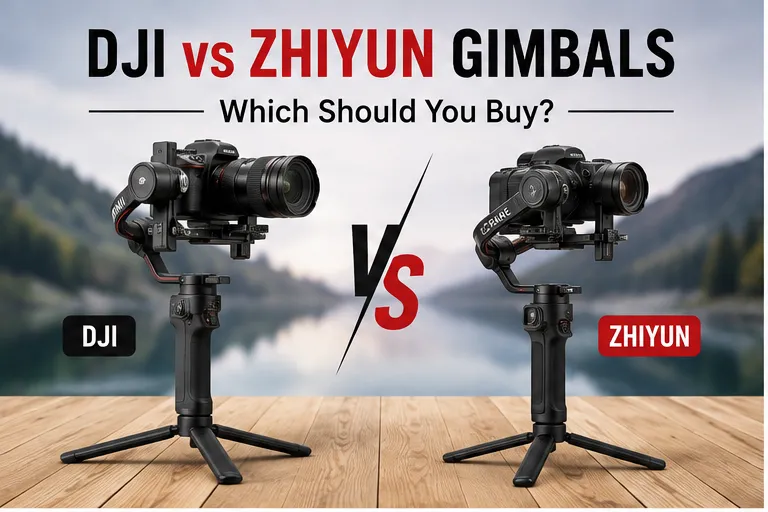
If your camera footage looks shaky while walking, panning or following a subject, a camera gimbal can make a major difference So, now questions is Which Camera Should You Buy?
A good gimbal helps keep your camera stable and produces smoother, more professional-looking footage. But when you start looking for one, two names appear again and again: DJI and Zhiyun.
So, Which Camera Should You Buy?
For beginners in India, the decision is not simply about choosing the most expensive gimbal. You need to consider your camera and lens combination, payload, battery life, controls, app features, portability and budget.
In this DJI vs Zhiyun gimbal India guide, we compare the two brands and explain what beginners should look for before buying a camera stabiliser.
Whether you use a mirrorless camera, DSLR or action camera, this guide will help you choose a gimbal that fits your setup.
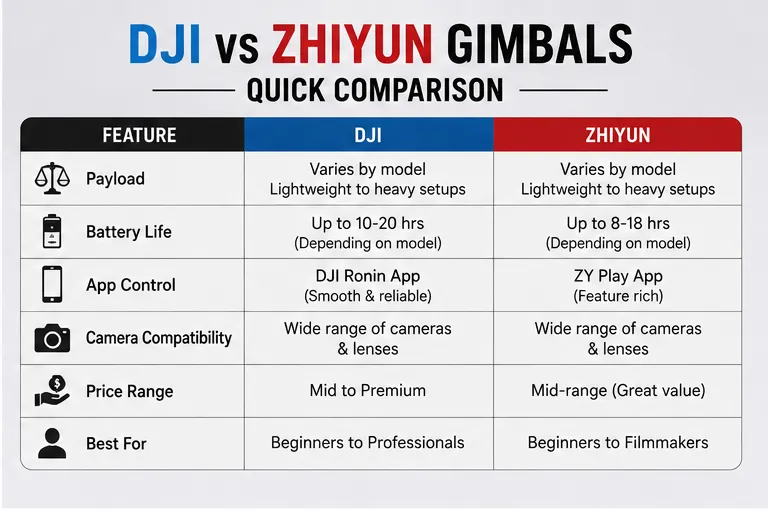
DJI vs Zhiyun Gimbal: Quick Comparison
- Best Known For: DJI Camera stabilisation & creator ecosystem · Zhiyun Camera stabilisers & value
- Beginner Options: DJI Strong range of compact and full-size models · Zhiyun Compact and full-size options
- App Control: DJI DJI Ronin app on supported models · Zhiyun ZY Play / Zhiyun ecosystem on supported models
- Payload: DJI Depends on model · Zhiyun Depends on model
- Battery Life: DJI Depends on model · Zhiyun Depends on model
- Camera Compatibility: DJI Check exact camera/lens combination · Zhiyun Check exact camera/lens combination
- Best For: DJI Beginners, creators & professionals · Zhiyun Beginners, creators & filmmakers
- Camera Mart Options: DJI RS 2, Ronin SC, RS 3 Mini, RS 4 Mini · Zhiyun Crane 4
The important point is that DJI vs Zhiyun is not a simple brand-versus-brand decision. A lightweight DJI gimbal may be better for one camera setup, while a Zhiyun model with higher payload may be more suitable for another.
What Is a Camera Gimbal?
A camera gimbal is a motorised stabilisation system designed to reduce unwanted camera movement.
When you walk while holding a camera, your hands naturally move up, down and sideways. A gimbal uses motors and sensors to compensate for many of those movements and keep the camera more stable.
This is particularly useful for:
- Walking shots
- Cinematic movements
- Wedding videos
- Travel videos
- YouTube content
- Product videos
- Event coverage
- Short films
- Social media reels
- Interviews
- Follow shots
A gimbal is different from a tripod because it is designed for movement.
A tripod keeps the camera stationary.
A gimbal helps you move while keeping the camera stable.
DJI vs Zhiyun: Which Brand Is Better?
Both DJI and Zhiyun make capable camera stabilisers.
Instead of asking which brand is universally better, ask:
Which gimbal is better for my camera, lens and type of shooting?
Which Camera Should You Buy
This is especially important because payload requirements can change dramatically depending on the camera body and lens you mount.
For example, a compact APS-C camera with a small prime lens requires much less stabilisation capacity than a full-frame camera with a large zoom lens.
That means a smaller gimbal may be ideal for one creator and completely unsuitable for another.
DJI Gimbals: What Makes Them Popular?
DJI is one of the most recognisable names in camera stabilisation.
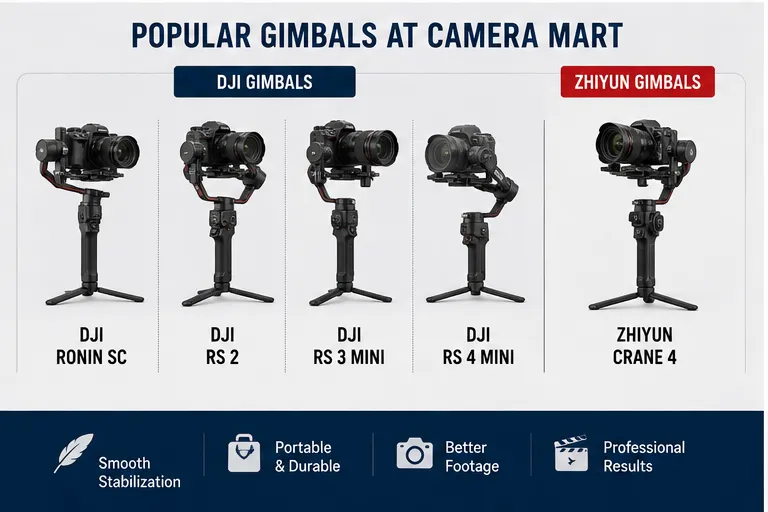
Camera Mart currently has several DJI options listed, including the DJI Ronin SC, DJI Ronin RS 2, DJI RS 3 Mini Combo and DJI RS 4 Mini Combo.
This gives buyers different options depending on camera size and budget.
DJI RS 3 Mini
The DJI RS 3 Mini is particularly interesting for beginners and creators who want a relatively lightweight camera gimbal.
DJI specifies a tested payload of 0.4–2 kg, while the gimbal weighs about 795 g in portrait mode or 850 g in horizontal shooting mode, excluding the extended grip/tripod. DJI also rates its battery operating time at up to 10 hours under specified test conditions.
This makes it a useful option for photographers and creators who do not want to carry a large professional gimbal.
Why Consider the DJI RS 3 Mini?
It is particularly suitable for:
- Lightweight mirrorless cameras
- Travel creators
- YouTube creators
- Social media video
- Short-form content
- Beginner filmmakers
- People who frequently switch between horizontal and vertical video
The RS 3 Mini also supports native vertical shooting, which can be useful when creating content for platforms that favour vertical video.
Best for: Beginners and creators using relatively lightweight camera setups.
DJI Ronin SC: A Budget-Friendly Option
The DJI Ronin SC is an older model, but that does not automatically make it a bad choice.
When buying used camera equipment, older models can become attractive because the lower price allows buyers to get into a stabilisation system without spending as much as they would on newer equipment.
Camera Mart currently lists the DJI Ronin SC Gimbal in its DJI collection.
The important thing when considering an older gimbal is compatibility.
Before buying, check whether your exact camera and lens combination is supported and whether all the required accessories are included.
Best for: Budget-conscious buyers with compatible lightweight camera setups.
DJI Ronin RS 2: For Heavier Camera Setups
The DJI Ronin RS 2 is a larger stabilisation system than compact models such as the RS 3 Mini.
This makes it more relevant to photographers and filmmakers using heavier camera bodies and lenses.
Camera Mart currently lists the DJI Ronin RS 2 Gimbal in its DJI category.
If your setup includes a larger full-frame body, heavier zoom lens or additional accessories, a higher-capacity gimbal may be more appropriate than choosing a compact model simply because it is easier to carry.
Best for: More demanding camera setups and advanced users.
DJI RS 4 Mini: A Newer Compact Option
The DJI RS 4 Mini is another option currently listed by Camera Mart.
Its position in the lineup makes it relevant to creators who want a compact modern gimbal while still working with interchangeable-lens cameras. Camera Mart currently lists the RS 4 Mini Combo alongside the RS 3 Mini.
When comparing the RS 3 Mini and RS 4 Mini, check the exact compatibility requirements and features that matter to your workflow rather than assuming the newer model is automatically the better purchase.
Best for: Creators looking for a newer compact DJI setup.
Zhiyun Gimbals: What Makes Them Worth Considering?
Zhiyun is another established name in camera stabilisation and offers gimbals designed for different camera sizes and shooting styles.
Camera Mart currently lists the Zhiyun Crane 4 Gimbal, priced in a used range of ₹22,500–₹32,500 at the time checked.
This gives Camera Mart buyers an alternative to DJI when comparing camera stabilisers.
Zhiyun Crane 4: A More Capable Camera Gimbal
The Zhiyun Crane 4 is designed for more demanding camera setups than very small smartphone-style stabilisers.
This makes it worth considering if you use a larger mirrorless or DSLR body with a heavier lens.
The exact payload and compatibility should always be checked against your camera and lens combination before purchasing.
For buyers looking for a more capable Zhiyun stabiliser rather than an ultra-light option, the Crane 4 can be an interesting choice.
Best for: Enthusiasts, filmmakers and users with larger camera setups.
DJI vs Zhiyun: Payload
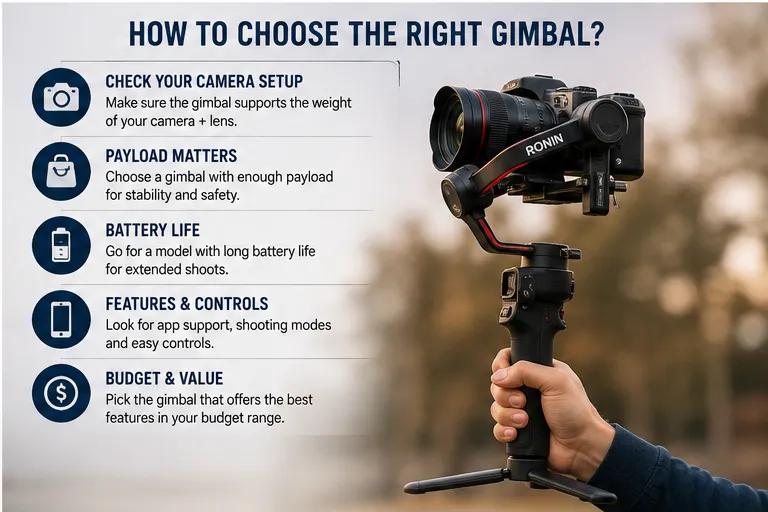
Payload should be one of the first specifications you check before buying a gimbal.
Payload means the amount of camera equipment the gimbal is designed to handle.
But do not calculate only the weight of your camera body.
You also need to consider:
- Lens
- Battery
- Memory card
- Camera cage
- Microphone
- External monitor
- Follow-focus system
- Other accessories
For example, the DJI RS 3 Mini has a tested payload range of 0.4–2 kg.
If your complete setup is close to or above the gimbal’s supported range, choose a larger stabiliser instead.
Why Payload Matters
A gimbal that is technically capable of supporting your camera may still not be the ideal choice if you are operating close to its limit.
A properly balanced setup allows the motors to work more effectively and can make the gimbal easier to operate.
Always check the manufacturer’s camera compatibility information before buying.
DJI vs Zhiyun: Battery Life
Battery life matters more than many beginners expect.
If you are filming weddings, events or travel content, you may spend several hours carrying and operating the gimbal.
The DJI RS 3 Mini is rated for up to 10 hours of operating time under DJI’s specified stationary and balanced test conditions. DJI also notes that actual operating time decreases when the gimbal is moving.
Zhiyun’s specifications also vary by model.
For example, Zhiyun rates the Crane-M 3 at up to 8 hours under specified test conditions.
The Zhiyun Crane-M 3S is rated at up to 7.5 hours under its stated test conditions.
Therefore, do not compare battery numbers without considering the specific gimbal model.
Important: Manufacturer battery figures are test results. Real-world runtime can be lower depending on camera load, movement, balancing and operating conditions.
DJI vs Zhiyun: App and Camera Control
Modern gimbals are more than three motors and a handle.
Many models can communicate with compatible cameras or smartphones and provide additional control through their apps.
DJI’s RS 3 Mini supports Bluetooth and the Ronin app ecosystem.
Zhiyun also provides app-based functionality on supported models.
These features can include functions such as:
- Camera control
- Firmware updates
- Calibration
- Shooting modes
- Timelapse features
- Motion control
- Settings management
However, compatibility can vary significantly between cameras.
Do not assume that every camera gets every feature.
Always check whether your exact camera model supports the control functions you want before buying.
DJI vs Zhiyun: Which Is Easier for Beginners?
For a beginner, the best gimbal is usually the one that is:
- Compatible with your camera
- Easy to balance
- Light enough to carry
- Powerful enough for your setup
- Simple enough to operate
A heavier professional gimbal may offer more capacity, but that does not mean it is automatically better for a beginner.
If you are using a small mirrorless camera with a compact lens, a smaller gimbal can make more sense.
If you are using a large full-frame camera and heavy zoom lens, you may need the additional capacity of a larger model.
DJI vs Zhiyun for Mirrorless Cameras
Mirrorless cameras are increasingly popular for video because they combine good image quality with relatively compact bodies.
But mirrorless camera sizes vary significantly.
A small APS-C camera with a 23mm or 35mm prime lens is very different from a full-frame camera with a 24-70mm f/2.8 lens.
Before choosing a gimbal, calculate the weight of your complete shooting setup.
Then compare that weight with the gimbal’s supported payload.
DJI vs Zhiyun for DSLR Cameras
DSLR cameras can also be used with gimbals, but their larger bodies and lenses may require more payload capacity.
If you use an older DSLR with a lightweight kit lens, a compact gimbal may work.
If you use a professional DSLR with a heavy zoom lens and accessories, a larger stabiliser may be necessary.
This is one reason why you should not choose a gimbal solely based on the brand.
DJI vs Zhiyun for Beginners in India
If you are a beginner searching for a DJI vs Zhiyun gimbal in India, start with your camera rather than the brand.
Which Camera Should You Buy
Step 1: Identify Your Camera
Write down the exact camera model you use.
For example:
- Sony A6400
- Sony A7 III
- Canon EOS 200D
- Nikon D5600
- Panasonic Lumix G9
Step 2: Identify Your Lens
The lens can significantly change the total weight.
Record the lens model you normally use.
Step 3: Add Accessories
Include your:
- Microphone
- Cage
- Filter
- Monitor
- Follow focus
- Other accessories
Step 4: Calculate the Total Weight
Compare the complete setup with the manufacturer’s supported payload.
Step 5: Decide How Much Portability You Need
If you travel frequently, weight becomes important.
If you mainly shoot weddings or commercial projects, payload and battery life may matter more.
Used Gimbal Buying Guide: What Should You Check?
Buying a used gimbal can save money, but there are a few additional checks you should make.
1. Check All Three Motors
Turn the gimbal on and test the pan, tilt and roll motors.
Listen for unusual noises and look for abnormal movement.
2. Test the Joystick
Move the joystick in every direction and confirm that the gimbal responds smoothly.
3. Check the Axis Locks
If the gimbal has mechanical axis locks, inspect them carefully.
They should move and lock correctly.
4. Check Battery Health
An older gimbal may have reduced battery capacity.
Ask about usage and charging history where possible.
5. Check the USB and Charging Ports
Make sure the charging port works properly and inspect it for physical damage.
6. Test Camera Connection
If the gimbal supports camera control, connect your camera and test the available functions.
7. Check the Quick-Release Plate
Make sure the plate is included and locks securely.
8. Check the App Connection
Test Bluetooth or app connectivity where supported.
9. Inspect the Body
Look for major scratches, dents or signs of impact.
Small cosmetic marks are normal for used equipment, but heavy damage may indicate a previous drop.
10. Balance Your Actual Camera
The most important test is whether your camera and lens can be balanced properly.
A gimbal should not be purchased simply because the camera body appears compatible.
DJI vs Zhiyun: Which One Should You Buy?
There is no single answer for everyone.
Choose DJI if:
- You want a broad range of camera gimbals
- You prefer the DJI Ronin ecosystem
- You want compact and larger options
- You value integrated app and camera-control features
- You want options such as the RS 3 Mini or RS 4 Mini
Choose Zhiyun if:
- You want an alternative to DJI
- You are comparing value and features
- You need a larger stabiliser such as the Crane 4
- You already use Zhiyun equipment
- Your camera setup is compatible with the Zhiyun model you are considering
DJI vs Zhiyun: Best Choice by User
- Beginner with lightweight mirrorless: Recommended Direction DJI RS 3 Mini or similar compact option
- Travel creator: Recommended Direction Compact DJI or Zhiyun
- Social media creator: Recommended Direction Lightweight gimbal with vertical shooting
- Enthusiast with larger camera: Recommended Direction DJI RS 2 / Zhiyun Crane 4
- Professional filmmaker: Recommended Direction Choose based on complete camera rig and payload
- Budget-conscious used buyer: Recommended Direction Compare older DJI and Zhiyun models carefully
The recommendation should always be based on your actual camera setup.
Gimbal vs Action Camera: Which Should You Buy?
Not every video creator needs a camera gimbal.
If your priority is extreme portability, outdoor shooting or action footage, an action camera may be more practical.
Action cameras are designed to be compact and easy to carry, while a camera gimbal is more useful when you want cinematic movement with an interchangeable-lens camera.
For example:
Choose an action camera if you want:
- Lightweight travel gear
- Cycling or sports footage
- Adventure content
- Simple point-and-shoot video
- Maximum portability
Choose a gimbal if you want:
- Smooth walking shots
- Cinematic camera movements
- Professional-looking transitions
- Controlled pans and tracking shots
- Stabilisation for mirrorless or DSLR cameras
Camera Mart also carries action-camera options, so buyers can compare an action camera with a gimbal depending on their shooting requirements.
Why Buy a Used Gimbal?
A gimbal is another area where buying used can make sense.
Camera stabilisation technology has developed quickly, which means older gimbals can sometimes become available at much lower prices than their original retail price.
For a beginner, buying an older but compatible gimbal may leave more money available for:
- Camera lenses
- Batteries
- Memory cards
- Microphones
- Tripods
- Lighting
- Other accessories
However, condition matters.
A gimbal is a mechanical and electronic device with moving motors, so you should check it carefully before purchasing.
Current Gimbal Options at Camera Mart
Camera Mart currently lists five products in its Gimbal category:
- DJI Ronin RS 2 Gimbal
- DJI Ronin SC Gimbal
- DJI RS 3 Mini Combo Gimbal
- DJI RS 4 Mini Combo Gimbal
- Zhiyun Crane 4 Gimbal
The listed used-price ranges currently run from approximately ₹10,500 for the Ronin SC to ₹32,500 for the upper end of the Zhiyun Crane 4 listing, depending on model and condition. Prices and availability can change as used inventory changes.
This makes the category useful for buyers who want to compare different stabilisation options according to budget.
Frequently Asked Questions
Is DJI better than Zhiyun?
Neither brand is automatically better for every user. The right choice depends on your camera, lens, total payload, features, portability and budget.
Which is the best gimbal for beginners in India?
For beginners using a relatively lightweight mirrorless camera, a compact gimbal such as the DJI RS 3 Mini can be a practical option. DJI specifies a 0.4–2 kg tested payload for the RS 3 Mini.
Is a used DJI gimbal worth buying?
Yes, if it is in good condition and compatible with your camera setup. Check the motors, battery, axis locks, controls, charging port and camera connection before purchasing.
Is Zhiyun a good alternative to DJI?
Yes. Zhiyun offers camera stabilisers for different types of setups. The important thing is to compare the specific Zhiyun model with the DJI model you are considering rather than comparing the brands generally.
How much weight can a DJI gimbal carry?
It depends on the model. For example, DJI lists the RS 3 Mini’s tested payload as 0.4–2 kg. Always check the specifications of the exact gimbal before purchasing.
How long does a gimbal battery last?
Battery life varies by model and usage. DJI rates the RS 3 Mini at up to 10 hours under specified test conditions, while Zhiyun lists up to 8 hours for the Crane-M 3 under its specified test conditions. Actual runtime can be lower during active shooting.
Can I use a DSLR with a gimbal?
Yes, provided the gimbal supports the combined weight and dimensions of your DSLR, lens and accessories. Always check the manufacturer’s camera compatibility information.
Do I need a gimbal for an action camera?
Not always. Many action cameras are designed to provide stabilised footage without a traditional three-axis camera gimbal. If portability and action shooting are your priority, an action camera may be a simpler option.
What should I check before buying a used gimbal?
Check the motors, battery, axis locks, joystick, buttons, charging port, quick-release plate, Bluetooth/app connection and overall physical condition. Most importantly, test the gimbal with your actual camera and lens if possible.
Which is better for travel, DJI or Zhiyun?
A compact model from either brand can work well for travel. Weight, folded size and your camera setup are more important than the brand name alone.
Which Camera Should You Buy
Final Verdict: DJI vs Zhiyun Gimbal India
When comparing DJI vs Zhiyun gimbals in India, there is no reason to choose a brand first and your camera second.
Start with your camera.
Then consider your lens, total payload, shooting style and budget.
For lightweight mirrorless setups and beginner creators, a compact DJI option such as the DJI RS 3 Mini can be an attractive choice.
For larger setups, models such as the DJI Ronin RS 2 or Zhiyun Crane 4 may make more sense because they are designed for more demanding camera rigs.
If your budget is limited, an older used gimbal such as the DJI Ronin SC can also be worth considering if it is in good condition and compatible with your equipment.
The most important rule is simple:
Do not buy a gimbal based only on the brand or price. Buy one that can properly balance and control your complete camera setup.
Explore Camera Mart’s Gimbal collection to compare available stabilisers, including DJI Gimbals and Zhiyun Gimbals, and choose the option that fits your camera, shooting style and budget.