
Mirrorless cameras are becoming more popular, but does that mean DSLRs are outdated? Compare image quality, battery life, lenses, performance, and pricing to decide which DSLR vs mirrorless 2026 India. Choosing a camera has never been more exciting—or more confusing. If you’re planning to buy a camera in 2026, one of the biggest questions you’ll face is whether to choose a DSLR or a mirrorless camera. Both systems are capable of capturing stunning photos and videos, but they differ significantly in technology, size, autofocus, battery life, lens availability, and long-term value.
For years, DSLRs dominated the photography industry with their optical viewfinders, rugged construction, and impressive battery life. However, mirrorless cameras have rapidly evolved, offering faster autofocus, advanced video features, lightweight designs, and AI-powered subject tracking. Major brands like Canon, Nikon, and Sony are now investing heavily in mirrorless technology, making it the preferred choice for many photographers and content creators.
So, does that mean DSLRs are obsolete? Not necessarily. Depending on your budget, photography style, and future upgrade plans, a DSLR might still be the better option.
In this guide, we’ll compare DSLR vs mirrorless in 2026 across every important factor, helping Indian buyers make the right decision based on their needs rather than marketing hype.
What Is a DSLR Camera?
A DSLR (Digital Single-Lens Reflex) camera uses a mirror mechanism that reflects light from the lens into an optical viewfinder. When you press the shutter button, the mirror flips up, allowing light to reach the image sensor and capture the photograph.
This design has been the industry standard for decades and is trusted by professionals worldwide.
Advantages
- Excellent battery life.
- Optical viewfinder with no display lag.
- Comfortable grip for long shooting sessions.
- Large selection of affordable used lenses.
- Durable and weather-sealed professional models.
- Strong second-hand market in India.
Disadvantages
- Larger and heavier body.
- Slower autofocus during live view.
- Limited AI autofocus features.
- Fewer new DSLR models being released.
- Bulkier travel kit.
Even in 2026, DSLRs remain a solid choice for photographers who prioritize reliability, battery life, and affordability.
What Is a Mirrorless Camera?
A mirrorless camera eliminates the mirror mechanism found in DSLRs. Instead, light passes directly from the lens to the image sensor, and the camera displays the live image on an electronic viewfinder (EVF) or LCD screen.
This simpler design allows manufacturers to create lighter, smaller, and faster cameras packed with advanced technology.
Advantages of Mirrorless Cameras
- Compact and lightweight.
- Fast autofocus with AI subject detection.
- Excellent eye, face, animal, and vehicle tracking.
- Superior video capabilities.
- Silent electronic shutter.
- High-speed continuous shooting.
- Real-time exposure preview.
Disadvantages
- Shorter battery life compared to DSLRs.
- Some professional lenses are expensive.
- Electronic viewfinders consume power.
- Entry-level mirrorless cameras can cost more than used DSLRs.
Mirrorless cameras have become the primary focus of Canon, Nikon, Sony, Fujifilm, Panasonic, and other leading manufacturers.
DSLR vs Mirrorless: Key Differences
Before comparing specific features, let’s understand how these two camera systems differ.
| Feature | DSLR | Mirrorless |
|---|---|---|
| Viewfinder | Optical | Electronic |
| Size | Larger | Smaller |
| Weight | Heavier | Lighter |
| Autofocus | Good | Excellent |
| Video | Good | Outstanding |
| Battery Life | Excellent | Good |
| Silent Shooting | No | Yes |
| Burst Speed | Moderate | Very Fast |
| Live Preview | Limited | Real-Time |
| Future Support | Declining | Growing |
At first glance, mirrorless cameras appear to win in most categories. However, the best choice depends on your specific use case, budget, and shooting style.
Design and Portability
One of the first differences you’ll notice is size.
DSLR Design
Because DSLRs contain a mirror box and optical viewfinder, they are naturally larger and heavier.
This larger body provides:
- Better grip.
- Improved balance with heavy telephoto lenses.
- Comfortable handling during long events.
For wildlife and sports photographers using large lenses, the added weight can actually improve stability.
Mirrorless Design
Mirrorless cameras remove the mirror mechanism, allowing manufacturers to create much smaller bodies.
Benefits include:
- Easier travel.
- Less fatigue during long shoots.
- Smaller camera bags.
- Better portability for street photography.
If you frequently travel or vlog, the compact design is a major advantage.
Image Quality
Many people assume mirrorless cameras automatically produce better image quality than DSLRs.
That’s a myth.
Image quality depends far more on the camera’s sensor, processor, and lens than on whether it’s a DSLR or mirrorless.
For example:
- A full-frame DSLR and a full-frame mirrorless camera with similar sensors can produce nearly identical images.
- Lens quality often has a greater impact than the camera body itself.
Both systems deliver:
- Excellent dynamic range.
- Sharp detail.
- Accurate colors.
- High-resolution images.
- Professional RAW files.
For still photography, neither system has a clear advantage in pure image quality.
Autofocus Performance
Autofocus is where mirrorless cameras have made the biggest leap in recent years.
DSLR Autofocus
DSLRs use a dedicated phase-detection autofocus module when shooting through the optical viewfinder.
They perform well for:
- Portraits.
- Landscapes.
- Wildlife.
- Sports.
However, autofocus becomes slower in Live View mode because the mirror must remain raised.
Mirrorless Autofocus
Mirrorless cameras use on-sensor phase detection combined with advanced AI algorithms.
Modern systems can recognize and track:
- Human eyes.
- Faces.
- Animals.
- Birds.
- Cars.
- Motorcycles.
- Airplanes.
They maintain focus continuously across almost the entire frame, making them ideal for action photography and video.
For beginners, this technology also makes it easier to capture sharp images consistently.
Video Performance
Video is one area where mirrorless cameras have clearly taken the lead. If you’re a content creator, YouTuber, filmmaker, or vlogger, this section may influence your buying decision the most.
DSLR Video Performance
Most modern DSLRs can record Full HD and some premium models support 4K video. However, they have a few limitations:
- Slower autofocus during video
- Limited eye-tracking capabilities
- Larger and heavier setup
- Fewer advanced video features
DSLRs are still capable of producing excellent video, but they require more manual control and experience.
Mirrorless Video Performance
Mirrorless cameras are designed with modern video creators in mind.
Most current models offer:
- 4K and even 6K/8K recording (premium models)
- Fast continuous autofocus
- Eye and face tracking
- In-Body Image Stabilization (IBIS)
- High frame rate recording
- Log profiles for professional color grading
- Unlimited or extended recording times (model dependent)
If video is one of your priorities, mirrorless cameras are the better investment.
Battery Life
Battery life remains one of the biggest advantages of DSLRs.
DSLR Battery Life
Since an optical viewfinder doesn’t require power, DSLRs can shoot significantly longer on a single charge.
Typical battery life:
- 800–2,000 photos per charge (depending on the model)
This makes DSLRs ideal for:
- Weddings
- Wildlife photography
- Long travel days
- Outdoor adventures
Mirrorless Battery Life
Mirrorless cameras constantly power the electronic viewfinder and LCD, which consumes more energy.
Typical battery life:
- 300–800 photos per charge
Fortunately, many newer mirrorless cameras support:
- USB-C charging
- Power banks
- Fast charging
- USB power delivery while shooting
For most users, carrying one spare battery solves the issue.
Lens Ecosystem
Lenses often matter more than the camera body because they determine image quality and future upgrade options.
DSLR Lenses
DSLR systems have been around for decades, giving photographers access to a huge selection of lenses.
Advantages include:
- Large used lens market
- Affordable third-party options
- Wide range of focal lengths
- Proven reliability
Popular DSLR mounts:
- Canon EF
- Nikon F
If you’re buying used equipment, DSLR lenses offer excellent value.
Mirrorless Lenses
Mirrorless lens ecosystems continue to grow rapidly.
Popular mounts include:
- Canon RF
- Nikon Z
- Sony E
- Fujifilm X
Advantages:
- Sharper optical designs
- Faster autofocus motors
- Better edge-to-edge image quality
- Future-proof compatibility
While some premium mirrorless lenses are expensive, more affordable options are becoming available every year.
Low-Light Performance
Many buyers assume mirrorless cameras perform better in low light simply because they’re newer.
In reality, low-light performance depends on:
- Sensor size
- Sensor technology
- Lens aperture
- Image processor
A full-frame DSLR and a full-frame mirrorless camera with similar sensors will deliver comparable image quality in low-light conditions.
However, mirrorless cameras have an advantage when it comes to autofocus in dark environments. Their advanced subject detection often locks focus faster than older DSLR systems.
Optical Viewfinder vs Electronic Viewfinder
This is one of the biggest differences between DSLR and mirrorless cameras.
DSLR Optical Viewfinder
An optical viewfinder lets you see the scene directly through the lens using mirrors.
Benefits:
- Natural, real-world view
- No display lag
- No battery consumption
- Comfortable for long shooting sessions
Some photographers still prefer this traditional shooting experience.
Mirrorless Electronic Viewfinder (EVF)
An EVF displays a live digital preview captured by the sensor.
Advantages:
- Exposure preview before taking the photo
- White balance preview
- Live histogram
- Focus peaking
- Zebra warnings for overexposure
- Magnification for manual focus
These tools make shooting easier, especially for beginners and video creators.
Continuous Shooting (Burst Speed)
If you photograph sports, wildlife, or fast-moving subjects, burst speed matters.
DSLR Burst Shooting
Most entry-level DSLRs shoot around 5–7 frames per second (FPS), while professional models can reach 10–14 FPS.
Mirrorless Burst Shooting
Modern mirrorless cameras can achieve:
- 10–20 FPS with the mechanical shutter
- Up to 30–40 FPS (or more) with the electronic shutter on some flagship models
Combined with AI autofocus, this greatly increases the chances of capturing the perfect moment.
Weather Sealing and Durability
If you shoot outdoors, durability is an important consideration.
DSLR Durability
Professional DSLRs are known for their rugged construction.
Many feature:
- Magnesium alloy bodies
- Weather sealing
- Dust resistance
- Long-lasting mechanical reliability
They’ve proven themselves in demanding environments for years.
Mirrorless Durability
Premium mirrorless cameras now offer similar levels of weather sealing and robust construction.
However, entry-level models may not be as well protected, so always check the specifications before buying.
Learning Curve
DSLR
A DSLR offers a more traditional photography experience.
It’s ideal for those who want to:
- Learn manual exposure
- Understand optical composition
- Build classic photography skills
Some beginners may find the menu systems and controls slightly more intimidating.
Mirrorless
Mirrorless cameras are generally easier for beginners because they provide:
- Real-time exposure preview
- AI autofocus
- Touchscreen controls
- Guided shooting modes
- Live shooting aids
These features reduce the learning curve and help users achieve better results more quickly.
Price Comparison in India (2026)
Budget plays a major role when choosing between DSLR and mirrorless cameras.
Entry-Level (₹40,000–₹70,000)
- DSLR: Great value, especially in the used market.
- Mirrorless: More modern features, though options may be limited at the lower end.
Mid-Range (₹70,000–₹1,20,000)
- DSLR: Strong performance with access to affordable lenses.
- Mirrorless: Excellent balance of autofocus, video, and portability.
Premium (Above ₹1,20,000)
- Most new flagship releases are mirrorless, offering cutting-edge autofocus, video capabilities, and future lens support.
Best Cameras by Budget (2026)
Under ₹60,000
- Canon EOS 200D II (Used DSLR)
- Nikon D5600 (Used DSLR)
- Canon EOS R100 (Mirrorless)
- Sony ZV-E10 (Mirrorless)
₹60,000–₹1,00,000
- Canon EOS R50
- Sony Alpha a6400
- Nikon Z50 II (if available)
- Fujifilm X-S20
Above ₹1,00,000
- Canon EOS R8
- Sony Alpha a7 IV
- Nikon Z6 III
- Canon EOS R6 Mark II
Who Should Buy a DSLR in 2026?
Despite the growing popularity of mirrorless cameras, DSLRs still make sense for many photographers—especially if budget and battery life are top priorities.
A DSLR is a great choice if you:
- Are buying your first interchangeable lens camera on a tight budget.
- Mainly shoot landscapes, portraits, or travel photos.
- Prefer an optical viewfinder over an electronic display.
- Need excellent battery life for long shooting sessions.
- Want access to a large market of affordable used lenses.
- Already own Canon EF or Nikon F-mount lenses.
Recommended for: Beginners, hobbyists, students, and photographers looking for the best value.
Who Should Buy a Mirrorless Camera in 2026?
Mirrorless cameras are the future of photography and are now the primary focus of Canon, Nikon, Sony, Fujifilm, and Panasonic.
Choose a mirrorless camera if you:
- Create YouTube videos or social media content.
- Want the fastest autofocus with AI subject tracking.
- Travel frequently and prefer lightweight gear.
- Shoot sports, wildlife, or action photography.
- Need advanced video features like 4K, 6K, or Log recording.
- Want a camera system with long-term manufacturer support.
Recommended for: Content creators, vloggers, professionals, wildlife photographers, and users planning future upgrades.
DSLR vs Mirrorless: Pros and Cons
| DSLR | Mirrorless |
|---|---|
| ✔ Excellent battery life | ✔ Lightweight and compact |
| ✔ Affordable used cameras and lenses | ✔ Outstanding autofocus |
| ✔ Optical viewfinder | ✔ Superior video features |
| ✔ Comfortable grip | ✔ Silent shooting |
| ✔ Proven reliability | ✔ Real-time exposure preview |
| ✖ Larger and heavier | ✖ Shorter battery life |
| ✖ Slower Live View autofocus | ✖ Premium lenses can be expensive |
| ✖ Limited future development | ✖ EVF consumes more power |
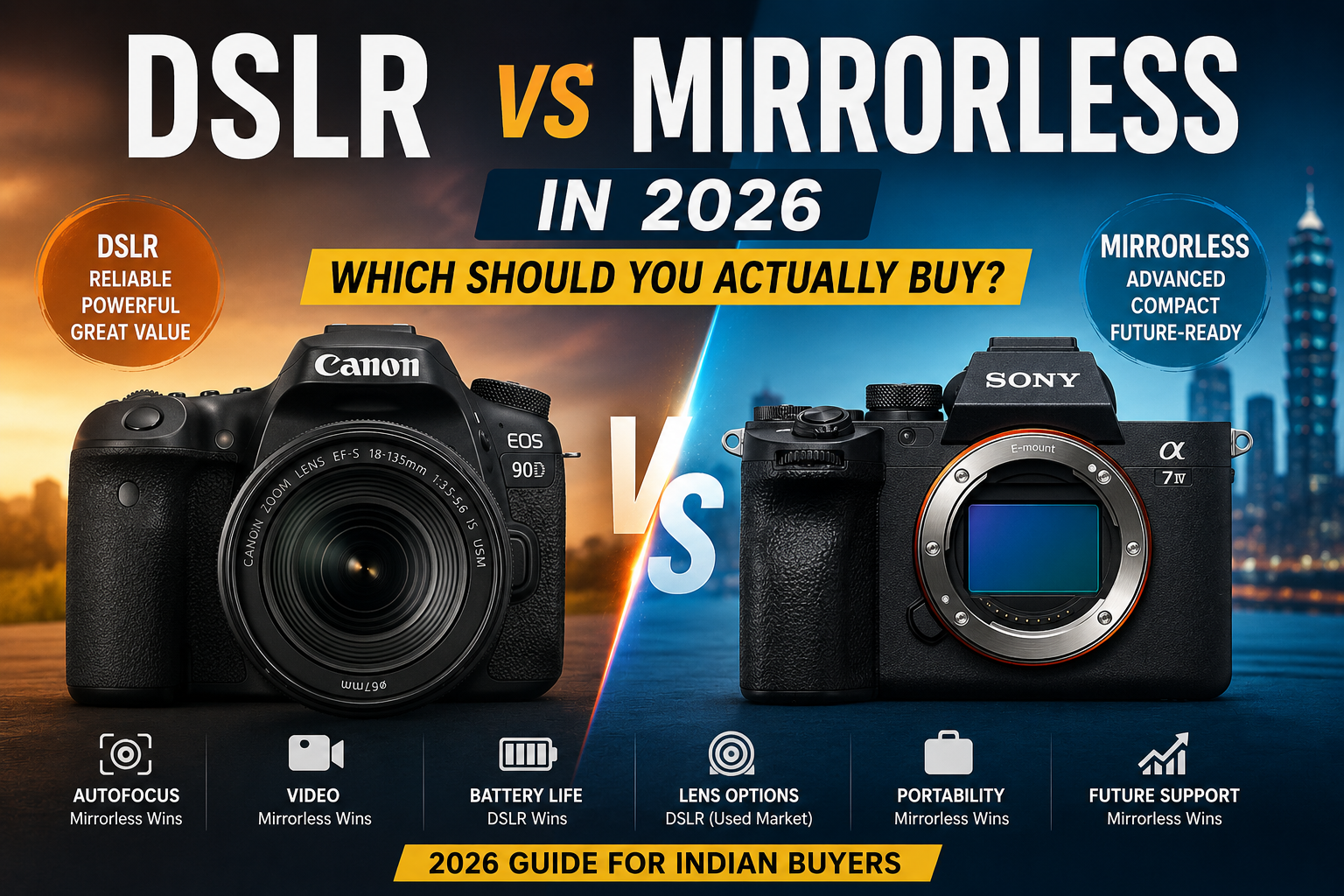
DSLR vs Mirrorless Comparison Summary
| Feature | Winner |
|---|---|
| Portability | Mirrorless |
| Autofocus | Mirrorless |
| Video | Mirrorless |
| Battery Life | DSLR |
| Lens Availability | DSLR (Used Market) |
| Future Support | Mirrorless |
| Beginner Friendly | Mirrorless |
| Budget Value | DSLR |
| Travel | Mirrorless |
| Sports & Wildlife | Mirrorless |
| Professional Video | Mirrorless |
| Overall Future Investment | Mirrorless |
Frequently Asked Questions
Are DSLRs discontinued in 2026?
Most major manufacturers have significantly reduced DSLR development, focusing instead on mirrorless systems. However, many DSLR models are still available new or used and continue to perform exceptionally well.
Is a DSLR still worth buying in India?
Yes. If you’re looking for the best value and don’t require advanced video or AI autofocus, a DSLR remains an excellent option—especially in the used market.
Which camera is better for beginners?
Mirrorless cameras are generally easier for beginners because of features like real-time exposure preview, eye autofocus, and touchscreen controls. However, a budget DSLR can still be a fantastic learning tool.
Is mirrorless better for photography?
Not always. Both DSLR and mirrorless cameras can produce outstanding image quality. Mirrorless systems mainly offer advantages in autofocus, speed, and video rather than pure image quality.
Which is better for YouTube and content creation?
Mirrorless cameras are the clear winner thanks to:
- Faster autofocus
- Better stabilization
- Flip screens
- Higher-quality video
- Compact size
- USB streaming support (on many models)
Should I switch from DSLR to mirrorless?
If you’re happy with your DSLR and your current lenses, there’s no urgent need to upgrade. However, if you’re investing in a new system for the long term, mirrorless is the better choice.
Final Buying Checklist
Before choosing between a DSLR and a mirrorless camera, ask yourself these questions:
- ✔️ What is my total budget, including lenses?
- ✔️ Will I mainly shoot photos or videos?
- ✔️ Do I need advanced autofocus?
- ✔️ How important is battery life?
- ✔️ Will I travel frequently with my camera?
- ✔️ Do I already own compatible lenses?
- ✔️ Do I plan to upgrade my camera system in the future?
- ✔️ Which brands offer the best service and support in my area?
Answering these questions will help you select the camera that best fits your needs instead of simply following trends.
Conclusion
The DSLR vs mirrorless 2026 India debate isn’t about which camera is universally better—it’s about choosing the right tool for your photography journey.
If you’re looking for an affordable camera with excellent battery life and access to a vast range of budget-friendly lenses, a DSLR is still a smart purchase in 2026. It’s an excellent choice for beginners, students, hobbyists, and anyone who primarily focuses on photography.
However, if you’re buying a camera for long-term use, creating video content, shooting sports or wildlife, or simply want the latest technology, a mirrorless camera is the better investment. With industry-leading autofocus, compact designs, advanced video capabilities, and continued support from major manufacturers, mirrorless systems represent the future of photography.
Ultimately, both systems are capable of producing stunning images. The best camera is the one that matches your budget, shooting style, and future goals. Evaluate your needs carefully, compare your options, and invest in a system that you’ll enjoy using for years to come.